
Question #6402908Single Choice
Writing and Reading
Question
Questions 23-33 are based on the following passage and supplementary material.
Marsupials Lend a Hand to Science
Marsupials (mammals that carry their young in a pouch) are a curiosity among biologists because they lack a corpus callosum, the collection of nerve fibers connecting the two hemispheres of the brain. In most other mammals, the left hemisphere of the brain controls the right side of the body, the right hemisphere controls the left, and the corpus callosum allows communication between the hemispheres. Scientists 23 are long believing that this structure enables complex tasks by sequestering skilled movement to a single hemisphere without sacrificing coordination between both sides of the body; this sequestration would explain handedness, the tendency to consistently prefer 24 one hand over the other, in humans. However, a recent finding of handedness in marsupials suggests that a 25 trait other than the presence of a corpus callosum 26 links as handedness: bipedalism.
Researchers at Saint Petersburg State University and the University of Tasmania observed marsupials walking on either two legs (bipeds) or four (quadrupeds) and performing tasks such as bringing food to their mouths. The scientists employed a mean handedness index; 27 negative scores indicated a left-forelimb preference and positive scores indicated a right-forelimb preference. While eating, the eastern gray kangaroo, red-necked wallaby, red 28 kangaroo and, brush-tailed bettong, all bipedal marsupials, preferred using their left forelimb, as revealed by 29 positive mean handedness index values less than 0.2 for all four species. These results suggest handedness among these animals.
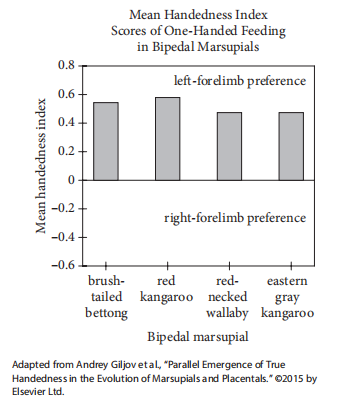
30 Having four feet, quadrupedal marsupials in the study did not show a strong preference for the use of one forelimb. For instance, gray short-tailed opossums and sugar gliders were assigned mean handedness values very close to zero—they used their right and left forelimbs nearly equally. In effect, the study provided no evidence of handedness among quadrupedal marsupials.
31 Kangaroos, though, still do not exhibit handedness to the extent that humans do. As the researchers noted, the quadrupeds typically live in trees and employ all four limbs in climbing. The bipeds, on the other hand, are far less arboreal, leaving their forelimbs relatively free for tasks in 32 whom handedness may confer an evolutionary advantage. Why the majority of marsupials studied preferred their left forelimbs while the majority of humans prefer their right remains a mystery, however, 33 as does the mechanism by which, in the absence of a corpus callosum, the hemispheres of the marsupial brain communicate.
23
Marsupials Lend a Hand to Science
Marsupials (mammals that carry their young in a pouch) are a curiosity among biologists because they lack a corpus callosum, the collection of nerve fibers connecting the two hemispheres of the brain. In most other mammals, the left hemisphere of the brain controls the right side of the body, the right hemisphere controls the left, and the corpus callosum allows communication between the hemispheres. Scientists 23 are long believing that this structure enables complex tasks by sequestering skilled movement to a single hemisphere without sacrificing coordination between both sides of the body; this sequestration would explain handedness, the tendency to consistently prefer 24 one hand over the other, in humans. However, a recent finding of handedness in marsupials suggests that a 25 trait other than the presence of a corpus callosum 26 links as handedness: bipedalism.
Researchers at Saint Petersburg State University and the University of Tasmania observed marsupials walking on either two legs (bipeds) or four (quadrupeds) and performing tasks such as bringing food to their mouths. The scientists employed a mean handedness index; 27 negative scores indicated a left-forelimb preference and positive scores indicated a right-forelimb preference. While eating, the eastern gray kangaroo, red-necked wallaby, red 28 kangaroo and, brush-tailed bettong, all bipedal marsupials, preferred using their left forelimb, as revealed by 29 positive mean handedness index values less than 0.2 for all four species. These results suggest handedness among these animals.
30 Having four feet, quadrupedal marsupials in the study did not show a strong preference for the use of one forelimb. For instance, gray short-tailed opossums and sugar gliders were assigned mean handedness values very close to zero—they used their right and left forelimbs nearly equally. In effect, the study provided no evidence of handedness among quadrupedal marsupials.
31 Kangaroos, though, still do not exhibit handedness to the extent that humans do. As the researchers noted, the quadrupeds typically live in trees and employ all four limbs in climbing. The bipeds, on the other hand, are far less arboreal, leaving their forelimbs relatively free for tasks in 32 whom handedness may confer an evolutionary advantage. Why the majority of marsupials studied preferred their left forelimbs while the majority of humans prefer their right remains a mystery, however, 33 as does the mechanism by which, in the absence of a corpus callosum, the hemispheres of the marsupial brain communicate.
23
Options
A
NO CHANGE
B
will long be believing
C
have long believed
D
long believe
Answer & Analysis
Click "Show Answer" to reveal the answer and analysis
Want More Practice Questions?
Access thousands of practice questions with detailed explanations on Scholardog.
Practice Now - It's Free!'%3e%3cpath%20fill-rule='evenodd'%20clip-rule='evenodd'%20d='M1.75736%201.75736C0%203.51472%200%206.34315%200%2012C0%2017.6569%200%2020.4853%201.75736%2022.2426C3.51472%2024%206.34315%2024%2012%2024C17.6569%2024%2020.4853%2024%2022.2426%2022.2426C24%2020.4853%2024%2017.6569%2024%2012C24%206.34315%2024%203.51472%2022.2426%201.75736C20.4853%200%2017.6569%200%2012%200C6.34315%200%203.51472%200%201.75736%201.75736ZM18.1727%206H16.026L12.4879%209.8345L9.42953%206H5L10.2925%2012.5633L5.27636%2018H7.42427L11.2963%2013.8054L14.6798%2018H19L13.4829%2011.0834L18.1727%206ZM16.4622%2016.7816H15.2724L7.50688%207.15475H8.78349L16.4622%2016.7816Z'%20fill='%23535A74'/%3e%3c/g%3e%3cdefs%3e%3cclipPath%20id='clip0_774_453'%3e%3crect%20width='24'%20height='24'%20fill='white'/%3e%3c/clipPath%3e%3c/defs%3e%3c/svg%3e)
'%3e%3crect%20id='大小'%20width='24'%20height='24'%20transform='translate(510%20188)'%20fill='%23fff'%20opacity='0'/%3e%3cpath%20id='路径_1057'%20data-name='路径%201057'%20d='M14,2a12,12,0,0,0-1.875,23.854V17.469H9.079V14h3.047V11.356c0-3.007,1.791-4.669,4.533-4.669a18.454,18.454,0,0,1,2.686.234V9.875H17.832a1.734,1.734,0,0,0-1.956,1.874V14H19.2l-.532,3.469h-2.8v8.385A12,12,0,0,0,14,2Z'%20transform='translate(507.999%20186)'%20fill='%23535a74'/%3e%3c/g%3e%3c/svg%3e)
'%3e%3cpath%20fill-rule='evenodd'%20clip-rule='evenodd'%20d='M0%2012C0%2017.6569%200%2020.4853%201.75736%2022.2426C3.51472%2024%206.34315%2024%2012%2024C17.6569%2024%2020.4853%2024%2022.2426%2022.2426C24%2020.4853%2024%2017.6569%2024%2012C24%206.34315%2024%203.51472%2022.2426%201.75736C20.4853%200%2017.6569%200%2012%200C6.34315%200%203.51472%200%201.75736%201.75736C0%203.51472%200%206.34315%200%2012ZM4.96484%209.49609V19.043H7.93359V9.49609H4.96484ZM4.72656%206.47656C4.72656%207.42578%205.49609%208.19531%206.44922%208.19531C7.39844%208.19531%208.16797%207.42188%208.16797%206.47656C8.16797%205.52734%207.39844%204.75781%206.44922%204.75781C5.49609%204.75781%204.72656%205.52734%204.72656%206.47656ZM16.0781%2019.043H19.043V13.8047C19.043%2011.2344%2018.4883%209.25781%2015.4844%209.25781C14.043%209.25781%2013.0742%2010.0508%2012.6797%2010.8008H12.6406V9.49609H9.79688V19.043H12.7578V14.3242C12.7578%2013.0781%2012.9922%2011.8711%2014.5352%2011.8711C16.0586%2011.8711%2016.0781%2013.2969%2016.0781%2014.4023V19.043Z'%20fill='%23535A74'/%3e%3c/g%3e%3cdefs%3e%3cclipPath%20id='clip0_774_461'%3e%3crect%20width='24'%20height='24'%20fill='white'/%3e%3c/clipPath%3e%3c/defs%3e%3c/svg%3e)

'%3e%3cpath%20fill-rule='evenodd'%20clip-rule='evenodd'%20d='M0%2012C0%206.34315%200%203.51472%201.75736%201.75736C3.51472%200%206.34315%200%2012%200C17.6569%200%2020.4853%200%2022.2426%201.75736C24%203.51472%2024%206.34315%2024%2012C24%2017.6569%2024%2020.4853%2022.2426%2022.2426C20.4853%2024%2017.6569%2024%2012%2024C6.34315%2024%203.51472%2024%201.75736%2022.2426C0%2020.4853%200%2017.6569%200%2012ZM12%205.83594C8.59688%205.83594%205.83594%208.59688%205.83594%2012C5.83594%2015.4031%208.59688%2018.1641%2012%2018.1641C15.4031%2018.1641%2018.1641%2015.4031%2018.1641%2012C18.1641%208.59688%2015.4031%205.83594%2012%205.83594ZM12%2015.9984C9.79219%2015.9984%208.00156%2014.2078%208.00156%2012C8.00156%209.79219%209.79219%208.00156%2012%208.00156C14.2078%208.00156%2015.9984%209.79219%2015.9984%2012C15.9984%2014.2078%2014.2078%2015.9984%2012%2015.9984ZM18.4078%207.0312C19.2%207.0312%2019.8469%206.38902%2019.8469%205.59214C19.8469%204.79995%2019.2%204.15308%2018.4078%204.15308C17.6156%204.15308%2016.9688%204.79526%2016.9688%205.59214C16.9688%206.38433%2017.6109%207.0312%2018.4078%207.0312Z'%20fill='%23535A74'/%3e%3c/g%3e%3cdefs%3e%3cclipPath%20id='clip0_774_455'%3e%3crect%20width='24'%20height='24'%20fill='white'/%3e%3c/clipPath%3e%3c/defs%3e%3c/svg%3e)